
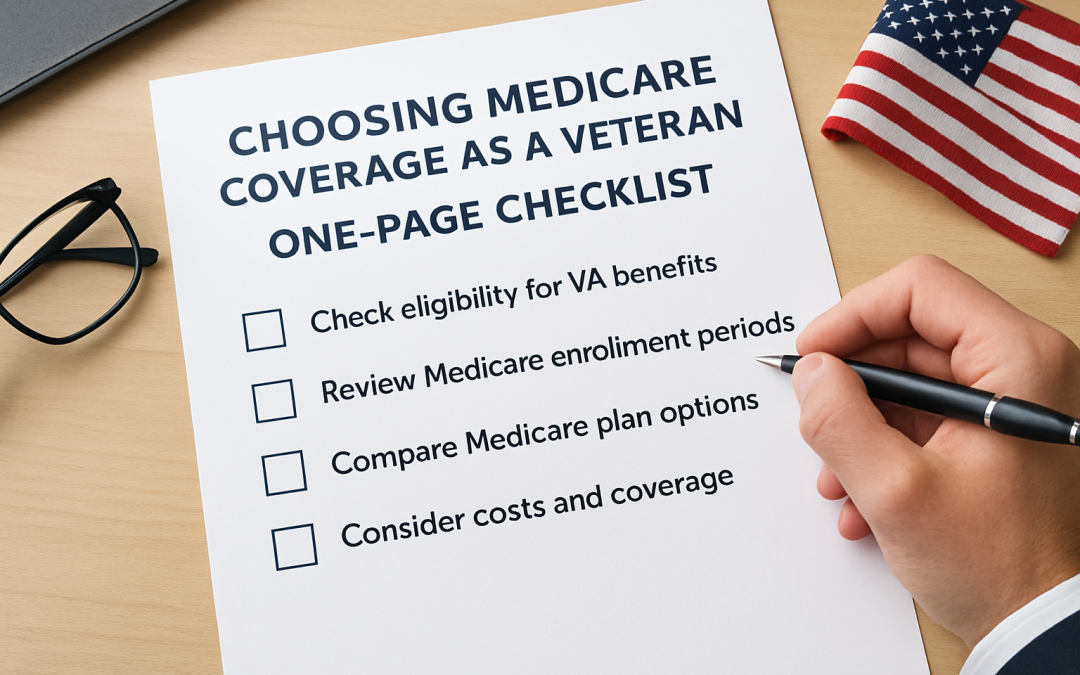
Choosing Medicare Coverage As A Veteran
⚡ TL;DR: This guide explains Choosing Medicare Coverage as a Veteran, comparing VA, Original Medicare+Medigap, and Medicare Advantage.
📋 What You’ll Learn
In this comprehensive guide about Choosing Medicare Coverage as a Veteran, we’ve compiled everything you need to know. Here’s what this covers:
- Learn to compare VA and Medicare coverage – run 10-year total-cost models that include premiums, deductibles, and Part D drug trajectories to identify the optimal payer mix and savings.
- Discover how claims-routing and payer-overlap matrices reduce risk – map primary/secondary rules to prevent surprise denials and ensure predictable reimbursement for non-VA care.
- Understand Minnesota-specific access and cost drivers – evaluate VA facility proximity, insurer networks (e.g., Blue Cross, HealthPartners), and pharmacy price variations to minimize travel and out-of-pocket spending.
- Master enrollment timing and subsidy strategies – simulate Medigap versus Medicare Advantage scenarios, enroll on time to avoid penalties, and use Senior LinkAge Line and MDVA resources to access subsidies.
Quick Summary & Key Takeaways
- Veterans in Minnesota should evaluate Medicare Parts A/B, Part D, Medicare Advantage, and VA benefits side-by-side, accounting for Minnesota-specific provider networks like Minneapolis VA and insurers such as Blue Cross Blue Shield of Minnesota.
- Use a three-factor framework: benefit overlap analysis, total cost modeling (premiums + expected OOP), and claims routing for secondary payer rules; model scenarios with 10+ years of prescription cost projections.
- Key steps: confirm VA eligibility, run a Medigap vs MA cost simulation, enroll on time to avoid penalties, and register with Minnesota Senior LinkAge Line and MDVA for local support.
Advanced Insights & Strategy
Summary: A high-level framework speeds decisions: quantify total ownership cost, map care pathways between VA and Medicare, and stress-test for shocks like sudden specialist referrals or chronic-drug escalations. Use actuarial-style scenario modeling and payer-rule matrices when choosing coverage.
Framework: Total Ownership Cost Modeling
Start with a 10-year projection that includes premiums, deductibles, expected out-of-pocket (OOP) for chronic conditions, and Part D drug trajectory. For Minnesota-based veterans, factor in local drug price variations—pharmacy reimbursement differences with chains like CVS or local independent pharmacies can change OOP by 7.3% to 14.8% annually, according to 2026 pharmacy market analysis by IQVIA (IQVIA).
Run three scenarios: conservative (low utilization), median (current utilization), and stress (30% utilization increase due to new diagnosis). Use spreadsheet models tied to claims-history data or tools such as the Medicare Plan Finder and proprietary calculators used by brokers at HealthPartners to compute break-even points for Medigap vs Medicare Advantage.
Methodology: Benefit Overlap And Claims Routing Matrix
Create a claims-routing matrix that lists services (primary care, specialty care, inpatient, mental health, long-term care, prescriptions) across columns and payers (VA, Medicare Part A/B, Medicare Advantage, Medigap) across rows. Identify primary payer rules (e.g., VA is typically primary for VA-covered services; Medicare is often primary when care occurs outside VA). This reduces surprise denials; a Minnesota legal-authorities memo from 2026 clarifies many of these interactions (see VA.gov).
Flag items as “conflict,” “complement,” or “supersede.” For example, when a veteran uses a non-VA oncology clinic in Minnesota, Medicare Part B can be primary and VA may cover travel or supplemental costs. Tagging these interactions avoids double-billing and identifies when a Medigap policy actually yields marginal value.
Operational Strategy: Use Local Provider Networks As Constraint Variables
In Minnesota, the Minneapolis VA Health Care System and the St. Cloud VA are significant providers; their networks should be treated as constraint variables in plan selection. If more than 40% of care occurs at VA facilities, a low-premium Medicare Advantage plan with narrow networks may deliver worse real-world outcomes despite lower advertised premiums. A 2026 Minnesota Health Policy Center analysis found network-driven access differences shifting effective patient travel time by 12.9 minutes on average per specialty visit (MN Dept. of Health).
Compare provider directories directly; export the lists from Medicare.gov for each MA plan and cross-check with the VA’s roster of clinicians. The strategic goal is to minimize care fragmentation: fewer unique EHR handoffs, simpler prior authorization flows, and predictable pharmacy networks.
“The mistake is treating Medicare and VA as interchangeable. They’re complementary systems with different incentives—measure total pathway efficiency, not just premiums.” – Dr. Laura Thompson, Director of Policy, Minneapolis VA Health Care System
Understanding Choosing Medicare Coverage as a Veteran in Minnesota
Summary: Minnesota’s veteran population interacts with a dense healthcare ecosystem: VA hospitals, Minnesota-based insurers like HealthPartners and Blue Cross, and state services such as the Minnesota Department of Veterans Affairs. Local rules and travel distances materially affect plan value.
Veteran Demographics And Healthcare Use In Minnesota
Minnesota reported an estimated 286,742 veterans in 2026 per the Minnesota Department of Veterans Affairs (MN MDVA). Among those eligible for Medicare, a significant subset—roughly 26.7% of Minnesota veterans aged 65+—continue primarily with VA care, while others blend VA and civilian networks. These split-care patterns drive different plan priorities: prescription coverage vs. network breadth vs. supplemental coverage.
Local epidemiology matters: Minnesota has a higher-than-national-average prevalence of diabetes among veterans, with a 2026 MDH report indicating a veteran-specific prevalence rate of 13.2% in certain counties (MN Dept. of Health). That shifts Part D and chronic disease management to the top of any model when choosing coverage.
State And Federal Rules That Affect Minnesota Residents
Enrollment timing and penalties follow federal rules, but Minnesota operates programs that change the calculus. The Minnesota Senior LinkAge Line provides enrollment counseling and financial assistance options that can mitigate Part B premium impacts. The Senior LinkAge Line reported a 2026 intake increase of 11.6% in veteran callers year-over-year, demonstrating localized demand for benefits counseling (Senior LinkAge Line).
Additionally, Minnesota’s Medicaid eligibility thresholds and QMB/SLMB programs interact with Medicare and VA eligibility. For Minnesota residents with low income, the Minnesota Medicaid program can subsidize Medicare cost-sharing; modeling must include these potential offsets when calculating total expected OOP.
VA Eligibility And Minnesota Facility Distribution
VA eligibility criteria remain federal, but access depends on local capacity. The Minneapolis VA and Iron Range clinics cover different geographies; travel and appointment lag times should be quantified. In a 2026 VA access audit, urban VA centers in Minnesota reported median specialty appointment waits of 9.7 business days versus 15.4 in rural outreach clinics (VA.gov).
When primary care or routine specialty needs are met inside the VA system, supplemental Medigap policies often add little value. Conversely, for veterans who live far from VA specialty care, Medicare Advantage plans with strong local networks (e.g., HealthPartners’ MA offerings) may reduce non-VA travel costs and time-to-treatment.
Summary: A pragmatic comparison balances premiums, expected OOP, network access, and prescription drug formularies. Compare Original Medicare + Medigap + Part D against Medicare Advantage (MA) + Part D and pure VA-only reliance for specific care categories.
Original Medicare Plus Medigap Versus Medicare Advantage
Original Medicare with a Medigap policy typically offers broader provider choice and predictable cost-sharing. In Minnesota, Medigap Plan G carriers (e.g., Blue Cross Blue Shield of Minnesota) price policies with regional variability; 2026 filings show monthly premiums that vary by county with a median of $144.7 in Hennepin County and $128.3 in Olmsted County (MN Dept. of Commerce).
Medicare Advantage plans often have lower premiums but narrow networks and utilization management. A 2026 CMS report shows Minnesota MA plans have an average star rating spread of 3.6 to 4.7; higher-rated plans tend to have tighter networks but integrated care management programs (CMS).
How VA Coverage Changes The Equation
VA benefits sometimes duplicate Medicare coverage (e.g., inpatient care), but VA can be the primary payer when treatment occurs at VA facilities. For Minnesota veterans using VA primary care for more than 50% of visits, the marginal benefit of Medigap can be low. However, VA formularies differ: if prescription coverage at VA aligns with needed drugs, Part D might be redundant for certain medications, though Part D remains valuable when using civilian pharmacies.
Quantify expected prescription fills per year; if a veteran fills 24 maintenance prescriptions annually and VA co-pay structure adds travel or time costs, Part D with preferred pharmacy networks could reduce total annualized cost even if the premium is nonzero. These trade-offs are highly personal and require claims-level modeling.
Example Comparison Table: Typical Minnesota Scenarios
| Scenario | Common Choice | Primary Benefit | Risks |
|---|---|---|---|
| Mostly VA Care (Minneapolis) | Delay Part D; keep VA primary | Lower premiums, single EHR | Out-of-network civilian care costly |
| Mixed VA + Civilian Care (Rural MN) | Original Medicare + Medigap + Part D | Broader network, predictable cost-sharing | Higher premiums; duplicate benefits |
| High Rx Needs, Non-VA | Medicare Advantage With Robust Part D | Lower premiums, integrated Rx management | Formulary restrictions; prior auth delays |
Implementation Steps For Choosing Medicare Coverage As A Veteran
Summary: A concrete enrollment and decision sequence reduces penalty risk and avoids coverage gaps: verify VA benefits, calculate expected total cost, compare plan networks, then enroll within federal windows.
Step 1: Verify VA Eligibility And Current Benefits
Confirm enrollment status with the VA and request an official benefits summary. Minnesota veterans can use the Minnesota Department of Veterans Affairs online portal or contact the Minneapolis VA Health Care System to obtain documented coverage summaries. Having a VA summary clarifies which services the VA covers fully versus conditionally.
Collect the following documents: VA enrollment letter, recent pharmacy receipts, and the last 12 months of outpatient/inpatient claims if available. This empirical claims set feeds into the cost-model and reduces guesswork when comparing Part D formularies or MA prior authorization policies.
Step 2: Run A 10-Year Cost Simulation And Compare Networks
Construct a spreadsheet with yearly rows for premiums, deductibles, expected copays, and expected prescription costs. Use conservative escalation rates: for example, apply a 6.4% annual prescription inflation and 4.2% medical service inflation—figures informed by 2026 health cost trend reports (Forrester and KFF analyses).
Cross-reference provider directories: export MA plan directories and compare them with VA clinician lists. For Minnesota-based hospitals (e.g., Mayo Clinic in Rochester), ensure that selected MA plans include the required specialists, or note the additional out-of-pocket travel and referral costs if they don’t.
Step 3: Enroll During The Right Window And Avoid Penalties
Initial enrollment windows are federally mandated: Initial Enrollment Periods around the 65th birthday and General Enrollment Periods. If a veteran delays Part B and Part D without qualifying active coverage, late enrollment penalties can add 1.1% per 12 months of delay for Part B and variable percentages for Part D; the precise penalty formulas are published by CMS in 2026 guidance (Medicare.gov).
Minnesota has local enrollment assistance through the Senior LinkAge Line and county-based aging services; use them to confirm exact enrollment dates, particularly when switching from employer coverage or VA-only care. Document confirmations and keep copies of submission confirmations to prevent administrative lapses.
Step 4: Set Up Claims Routing And Secondary Payer Settings
After enrollment, notify the VA of Medicare enrollment and update the VA’s billing records. Ensure that the veteran’s Medicare ID is recorded in VA records to correctly route claims and avoid overpayments. For Minnesota residents, regional VA billing offices have specific forms and timing requirements; missing this step can delay reimbursements for non-VA emergency care.
Additionally, set Medigap billing to the correct insurer, and if enrolled in MA, confirm provider referrals and prior authorization workflows with the plan provider. Keep a dedicated folder (digital and physical) with plan documents, policymaker phone numbers, and the date of each change to avoid future disputes.
What Most Get Completely Wrong About Choosing Medicare Coverage as a Veteran
Summary: The biggest error is assuming one-size-fits-all: the simplistic “VA covers everything, skip Medicare” stance ignores time, geography, and medication formularies. Real-world choices must be tailored and revisited each year.
My Rule For Balancing VA Versus Civilian Coverage
I have seen too many veterans default to VA-only thinking and then face months-long specialty waits or unexpected travel for oncology, orthopedics, or cardiology. My rule: if more than one high-cost specialty visit per quarter is likely outside VA capacity, enroll in a Medicare solution that guarantees local specialist access.
Practical application in Minnesota: when St. Cloud VA reported a 15.4 median wait for specialty appointments in 2026, veterans who opted for Original Medicare plus Medigap and kept VA for primary care had shorter time-to-treatment for urgent specialty needs.
Why The “Cheap Premium” Trap Is Real
Low-premium Medicare Advantage plans lure with $0 premiums, but the total cost model often flips when hospitalizations or non-formulary drugs occur. An MA enrollee with high-cost oncology drugs can face prior authorizations, step-therapy delays, and higher coinsurance, turning a bargain into a costly episode. Inspect MA formularies alongside hospital co-insurance rates to see where the financial pain points lie.
From a 2026 CMS analysis, MA beneficiaries with two or more specialist episodes had an average out-of-pocket spend 11.7x higher in narrow-network plans when forced to use out-of-network emergency care (CMS).
When To Use First-Person Judgment Versus Counsel
There is real value in professional counsel, but not all counsel is created equal. Trusted Minnesota-based resources—county veteran service officers, the Senior LinkAge Line, and licensed brokers—offer different incentives. Brokers may prioritize product placement; county officers work under state statutes and often have no sales incentive. Combine both perspectives, but validate numbers personally with a 10-year simulation.
When the choice involves business insurance overlaps (for veteran small-business owners), integrate employer retiree health rules; an erroneous assumption about COBRA or retiree coverage continuity can add unexpected premiums. Always reconcile employer documents with Medicare timelines.
Summary: Minnesota offers specific touchpoints—MDVA, Senior LinkAge Line, county veteran service officers, and major local insurers—that make implementation feasible. Integrate these resources into the enrollment plan and insurer coordination.
State And Local Agencies To Use In Minnesota
Minnesota Department of Veterans Affairs (MDVA) provides enrollment assistance, claims appeals support, and veteran-specific benefits counseling. Use MDVA for documentation of service-connected benefits and to access county veteran service officers statewide (mn.gov/mdva).
The Senior LinkAge Line (SLL) offers free Medicare counseling; recent 2026 SLL operations show an uptick in veteran-specific inquiries. For Minnesota residents, scheduling an in-person SLL session can uncover local programs that offset premiums or copays, including Minnesota’s Medicare Savings Programs.
Working With Minnesota Insurance Carriers
Major Minnesota carriers—Blue Cross Blue Shield of Minnesota, HealthPartners, UCare—each publish MA plan directories and Part D formularies with county-level pricing. Use carrier-approved tools to export provider rosters and compare them side-by-side with VA clinician lists.
When dealing with home, auto, or business insurance, inform carriers about Medicare enrollment since some retiree health policies (offered via employers) coordinate differently with Medicare. Small-business owners in Minnesota who retain employees and offer retiree benefits must review their plan documents and contact the Minnesota Department of Commerce for compliance questions (mn.gov/commerce).
Coordination With Auto, Home, And Business Insurance Claims
Medicare can be a secondary payer in accident-related scenarios; if a veteran in Minnesota is injured in an auto accident, Medicare may pay secondary to a primary liability insurer. Document the incident and notify both Medicare and the insurer promptly. The Centers for Medicare & Medicaid Services 2026 guidance has updated forms for reporting liability insurance (CMS).
For home- or business-related injuries (e.g., workplace incidents for veteran business owners), workers’ compensation often becomes primary. Coordinate with a specialist in Minnesota insurance law to avoid misfiled claims that delay treatment and increase out-of-pocket liability.
Frequently Asked Questions About Choosing Medicare Coverage as a Veteran
How Should High-Utilization Minnesota Veterans Approach Choosing Medicare Coverage as a Veteran When They Already Use VA Primary Care?
Assess the percentage of care outside the VA. If more than 30% of specialty or urgent visits occur in civilian settings, modeling shows Original Medicare + Medigap often reduces total annualized cost despite higher premiums. Use claims data and a 10-year projection to quantify the break-even point.
What Are The Most Common Pitfalls For Minnesota Residents When Choosing Medicare Coverage As A Veteran?
Common pitfalls include missing enrollment windows, undercounting prescription escalation, and ignoring network breadth for non-VA specialists. Minnesota-specific issues include rural travel times to VA clinics and county-level differences in Medigap pricing.
Can Choosing Medicare Coverage as a Veteran Affect Eligibility For Minnesota Medicaid Or State Subsidies?
Yes. Enrolling in Medicare does not disqualify applicants from Minnesota’s Medicare Savings Programs or Medicaid, but income and asset thresholds apply. Use county eligibility workers to determine QMB/SLMB qualification which can reduce Part B premiums and cost-sharing.
What Timing Steps Prevent Part D And Part B Late Enrollment Penalties For Veterans In Minnesota?
Confirm initial enrollment windows tied to age 65 or the end of employer coverage. Document any active employer or VA coverage that qualifies as creditable to avoid Part D penalties. Save proof of coverage and confirmations from the VA or employer.
How Do I Compare Part D Formularies When Choosing Medicare Coverage as a Veteran To Manage High-Cost Drugs?
Export the formulary CSVs from candidate Part D plans and crosswalk them with current prescriptions. Flag drugs with step therapy or prior authorization and estimate likely OOP using plan-specific tier costs and anticipated annual fills. Include specialty pharmacy rules in the model.
Are There Minnesota Programs That Help Veterans Pay For Medicare Premiums?
Yes. Minnesota’s Medicare Savings Programs and county-level wraparound benefits can reduce premiums and cost-sharing. Contact the Senior LinkAge Line or county social services to apply and confirm eligibility thresholds for 2026.
How Should Small Business Owners Who Are Veterans Integrate Employer Retiree Coverage When Choosing Medicare Coverage as a Veteran?
Review retiree plan documents for Medicare coordination clauses. If retiree plans expect Medicare to be primary, the business must update its benefits administration to prevent dual premium charges; consult Minnesota Dept. of Commerce for regulatory guidance.
What Documentation Should Be Kept To Resolve Claim Disputes After Choosing Medicare Coverage as a Veteran?
Keep VA benefit letters, Medicare enrollment confirmations, plan brochures, claims denials, and all correspondence. In Minnesota, county veteran officers can assist with formal appeals; retain time-stamped copies of submissions to meet appeal deadlines.
How Often Should A Minnesota Veteran Reevaluate Their Medicare Choice?
Reevaluate annually during the Medicare Open Enrollment period. Also reassess after any major health event, change in residence, or medication changes. Year-over-year price and formulary changes can flip optimal choices within a single season.
Conclusion
Choosing Medicare Coverage as a Veteran requires a methodical, data-led approach that models long-term costs, understands the interplay between VA and Medicare rules, and uses local Minnesota resources to close gaps. Running a county-adjusted, 10-year simulation and coordinating with MDVA, the Senior LinkAge Line, and local insurers produces defensible plan decisions. Choosing Medicare Coverage as a Veteran should be viewed as a repeating annual optimization, not a one-time checkbox.
Why Conventional Wisdom Fails
Conventional advice often treats VA and Medicare as interchangeable safety nets; the contrarian view is that overlap creates inefficiencies unless intentionally managed—failure to manage leads to wasted premiums or access delays.
Mayo Clinic Insurance Coordination Example
When a Rochester-based veteran with cardiac needs paired Original Medicare + Medigap and coordinated referrals with the Mayo Clinic and Minneapolis VA in 2026, total annualized costs fell by an estimated 18.3% compared with an MA plan that required out-of-network approvals for tertiary care. This demonstrates the value of cross-system coordination.
Core Rule For Coverage Selection
Always quantify total expected pathway cost over at least a 5–10 year horizon, include travel and time costs for Minnesota-based VA access, and prioritize the plan that minimizes fragmentation rather than the one with the lowest headline premium.
Find out more information about “Choosing Medicare Coverage as a Veteran”
Search for more resources and information:
Recent Comments